Electro the amazing machine!
FIRST THING'S FIRST! Electricity is shocking!
SECOND THINGS'S SECOND! Reading is a skill.
Alright, all assumptions aside and an awful attempt at alliteration also accounted as an absurd activity, always alluding and avoiding an autonomous anonymous animal and apropos asininity abate ASAP, again argue and ask authority as an aside against abrasive attitudes amongst aggregate asymmetrical asymptotes around awesome apples!
WHAT ON EARTH DID YOU SAY?????
WWEeeeeeeelllllllll ... since you asked, we're talking about electricity .. you know .. the flow of electrons through something, like a wire, or a fish.

Electrons are those things that float around the protons and neutrons of an atom so fast you can't see them! Well, technically "seeing" an electron is "observing" it, but we're not trying to learn Quantum Physics here ...
An electron has a negative charge, and we're not talking about it owning someone money either! We're talking about the force! The Electromagnetic Force! It's all around us and it's what electrons love to move through. Electrons that travel through the Electromagnetic spectrum and enter your eyes as color are called light waves. Vibrating metal and making it release its electrons through the EMS are called radio waves. Side note, we should start calling the EMS the Luminiferous Aether again, just cause that sounds way cooler!
But when an electron moves through the EMS of certain types of metals, some interesting things happen. The metal doesn't have any space to hold on to that electron, so it has to shed one off some where and put it else where, because electrons just gots to go, ya know!!
WARNING: SCIENCE CONTENT!!!
What happens when the metal gets an extra electron is that extra electron "bumps" into one that's attached to the nucleus of the metal atoms, which then "bumps" into another one, which then "bumps" into another one, and so forth, and so on, until it finally "bumps" the last one off of the end of the long atomic domnio chain. We can actually see this bumping happen with some metals because it starts to glow a bright red if you shove enough electrons through it fast enough. The glow is all of the electrons being "bumped" off of the metal and being turned into heat energy because of the "bumping" causing friction, which causes the electrons to change energy levels which causes glowing of red, infrared, and other colors lower in energy on the EMS as the electrons go from particles of the nucleui to waves in the Electromagentic Spectrum and then back to particles as they attract to other nearby objects with protonic mass.
WE NOW TAKE YOU BACK TO YOUR REGULARLY SCHEDULED PROGRAM
So the "electr" part came from "electron" and the "icity" part came from John Jacob Jingle Heimer Icity, who owned the Electron Moving Co., and he would say that his name is your name too, and whenever they would go out, people would always shout "There goes John Jacob Jingle Heimer Icity! LA! LA! LA! LA! LA! LA! LA! LA!"
But John got tired of that and just said, call it "Electricity!".
So what does all of that have to do with programming you ask!
EVERYTHING!!!!!!!!
When we figured out that electricity could flow kind of like water, we could start doing things, like creating radio waves that disturb the EMS like a wave on a pond, and at a consistent frequency at that!!! We could create our own wave pools to surf the electromagnetic spectrum like it was a sunny day on the beach!
We just needed to learn how to control the amount of electrons flowing, which we measure in amps, and the pressure of those amps, meaning how hard and fast we pushed those electrons through something, which we measure in volts. We at least knew that if you take the number of amps something can give, and multiply by the number of volts it's using, you get the number of watts consumed, which tells you how many electrons that device converted into something (like words on a screen). We also know that we were happy none of these Scientist were named DingleSchmirffenHagenPotty, otherwise we might say that these devices consumes 57 DingleSchmirffenHagenPotty's of energy.

Once we could grasp a smoodgen of what we were doing with electricity and magnets, we started creating crazy electrical grids and using electrical motors to drive things!
Some systems used A/C, or alternating current, which means the flow of electrons go one way through the wire, and then reverses!
Other systems used D/C, or direct current, which means the flow of electrons always goes in the same direction!
A/C is usually created with large spinning magnets while D/C is usually created with batteries or current producing cells (like solar cells, not sea shells just seeing if you're still awake). A/C is great for delivering large amounts of electrical energy across large distances, but it's dirty and noisy while D/C is great for keeping the electricity flowing in a calm and controlled manner.
So once we started hooking electrical motors up to our mechanical computers to turn the gears for us, the first electronic computer was born! We were just outright done doing anything manual any more!
It took longer for a human to grab the paper and pencil, than it did those electrical rotors to crank out that polynomial to figure out where the enemy was and send them a war head full of love and daisies.
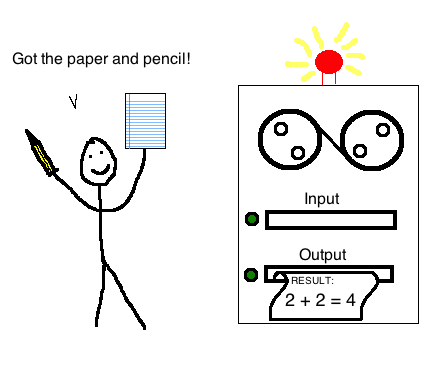
These electromechanical systems were still slow compared to the devices that we could have and they only worked on 1 problem, which meant creating an electromechanical system for every math problem you wanted to solve! Well that was all about to change once that dude J.A. Fleming came around and yelled out into the London streets about his new purely electronic gear-switch-thingy, the Fleming valve! It was a type of a not-so-intuitively named vacuum tube that, interestingly enough, only let electricity flow in one direction; he basicity created a one-way street for electrons.
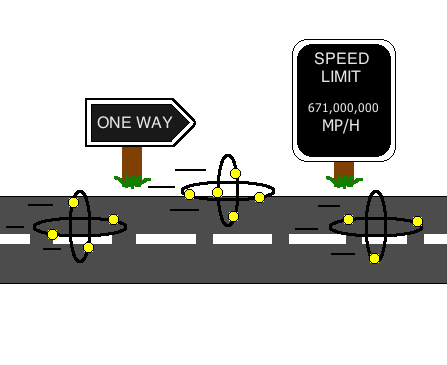
Oh the joy that people had, because we could turn those huge honking beasts of gear boxes, into a few little light bulbs!
People were inclined to say "Welcome in the digital revolution, where 1's and 0's talk, and all other numbers walk!"
But those who were in the "know" had to sit them folks down and say "WHHOOOOOaaaaaaa ... slow down there cowboy!! We're not quite there just yet!"
Before that new fangelled 1 and that precocious 0 came about, we used those Fleming valves to create a crazy thing called a rectifying diode. We also got better at making smaller resistors, capacitors, transistors and light switches (technically called an electrical relay). Those tube amps and diodes were used to turn A/C to D/C as well as control how many electrons (based on volts or amps) signaled an "on" state (let the electrons pass), in essence, an electrical valve. The resistors where used to slow, or stop, the flow of electrons, and even divide them. The capacitors where used to store electrons, the transistors were used to add (amplify) the electrons, and the relays were used as input.
With A/C-to-D/C, amplifiers and stored energy, that meant we could finally rock out!!
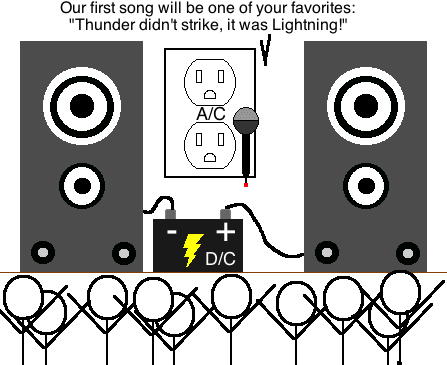
It also meant that we could better control the flow of electrons and create massive series of switches and blinky lights that made us feel good at night, like a warm blanky. One of our first warm blankys was named ENIAC and we loved it so!
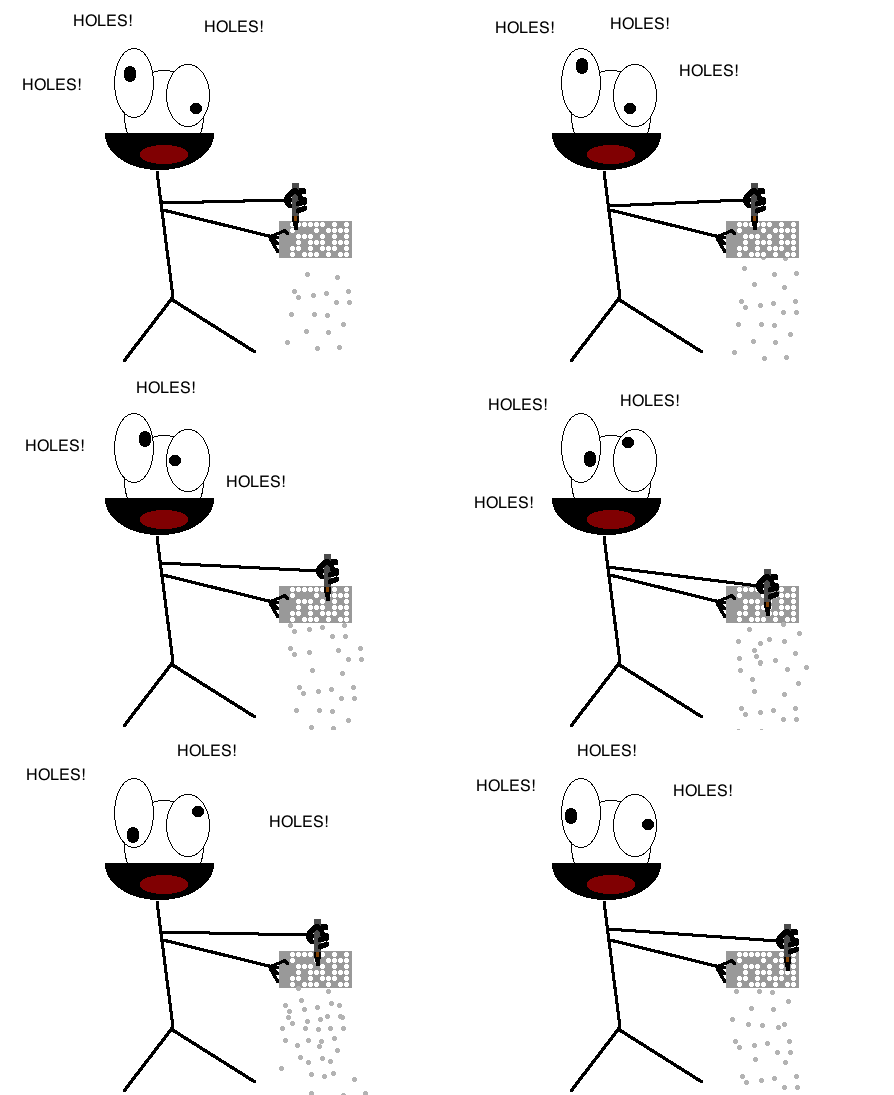
ENIAC used a whole lot of those diodes, vacuum tubes, capacitors, resistors and relays to create a programable, purely electrical, computer that could take inputs (in the form of paper cards with a whole lot of holes in it called, a punch card), and then print out the result in the same card format!
Finally, we could get rid of the tedium of cranking gears and replace it with the tedium of punching holes in cards!!
And that's how digits were born ... soo cuuute!
FIRST THING'S FIRST! Electricity is shocking!
SECOND THINGS'S SECOND! Reading is a skill.
Alright, all assumptions aside and an awful attempt at alliteration also accounted as an absurd activity, always alluding and avoiding an autonomous anonymous animal and apropos asininity abate ASAP, again argue and ask authority as an aside against abrasive attitudes amongst aggregate asymmetrical asymptotes around awesome apples!
WHAT ON EARTH DID YOU SAY?????
WWEeeeeeeelllllllll ... since you asked, we're talking about electricity .. you know .. the flow of electrons through something, like a wire, or a fish.
Electrons are those things that float around the protons and neutrons of an atom so fast you can't see them! Well, technically "seeing" an electron is "observing" it, but we're not trying to learn Quantum Physics here ...
An electron has a negative charge, and we're not talking about it owning someone money either! We're talking about the force! The Electromagnetic Force! It's all around us and it's what electrons love to move through. Electrons that travel through the Electromagnetic spectrum and enter your eyes as color are called light waves. Vibrating metal and making it release its electrons through the EMS are called radio waves. Side note, we should start calling the EMS the Luminiferous Aether again, just cause that sounds way cooler!
But when an electron moves through the EMS of certain types of metals, some interesting things happen. The metal doesn't have any space to hold on to that electron, so it has to shed one off some where and put it else where, because electrons just gots to go, ya know!!
WARNING: SCIENCE CONTENT!!!
What happens when the metal gets an extra electron is that extra electron "bumps" into one that's attached to the nucleus of the metal atoms, which then "bumps" into another one, which then "bumps" into another one, and so forth, and so on, until it finally "bumps" the last one off of the end of the long atomic domnio chain. We can actually see this bumping happen with some metals because it starts to glow a bright red if you shove enough electrons through it fast enough. The glow is all of the electrons being "bumped" off of the metal and being turned into heat energy because of the "bumping" causing friction, which causes the electrons to change energy levels which causes glowing of red, infrared, and other colors lower in energy on the EMS as the electrons go from particles of the nucleui to waves in the Electromagentic Spectrum and then back to particles as they attract to other nearby objects with protonic mass.
WE NOW TAKE YOU BACK TO YOUR REGULARLY SCHEDULED PROGRAM
So the "electr" part came from "electron" and the "icity" part came from John Jacob Jingle Heimer Icity, who owned the Electron Moving Co., and he would say that his name is your name too, and whenever they would go out, people would always shout "There goes John Jacob Jingle Heimer Icity! LA! LA! LA! LA! LA! LA! LA! LA!"
But John got tired of that and just said, call it "Electricity!".
So what does all of that have to do with programming you ask!
EVERYTHING!!!!!!!!
When we figured out that electricity could flow kind of like water, we could start doing things, like creating radio waves that disturb the EMS like a wave on a pond, and at a consistent frequency at that!!! We could create our own wave pools to surf the electromagnetic spectrum like it was a sunny day on the beach!
We just needed to learn how to control the amount of electrons flowing, which we measure in amps, and the pressure of those amps, meaning how hard and fast we pushed those electrons through something, which we measure in volts. We at least knew that if you take the number of amps something can give, and multiply by the number of volts it's using, you get the number of watts consumed, which tells you how many electrons that device converted into something (like words on a screen). We also know that we were happy none of these Scientist were named DingleSchmirffenHagenPotty, otherwise we might say that these devices consumes 57 DingleSchmirffenHagenPotty's of energy.
Once we could grasp a smoodgen of what we were doing with electricity and magnets, we started creating crazy electrical grids and using electrical motors to drive things!
Some systems used A/C, or alternating current, which means the flow of electrons go one way through the wire, and then reverses!
Other systems used D/C, or direct current, which means the flow of electrons always goes in the same direction!
A/C is usually created with large spinning magnets while D/C is usually created with batteries or current producing cells (like solar cells, not sea shells just seeing if you're still awake). A/C is great for delivering large amounts of electrical energy across large distances, but it's dirty and noisy while D/C is great for keeping the electricity flowing in a calm and controlled manner.
So once we started hooking electrical motors up to our mechanical computers to turn the gears for us, the first electronic computer was born! We were just outright done doing anything manual any more!
It took longer for a human to grab the paper and pencil, than it did those electrical rotors to crank out that polynomial to figure out where the enemy was and send them a war head full of love and daisies.
These electromechanical systems were still slow compared to the devices that we could have and they only worked on 1 problem, which meant creating an electromechanical system for every math problem you wanted to solve! Well that was all about to change once that dude J.A. Fleming came around and yelled out into the London streets about his new purely electronic gear-switch-thingy, the Fleming valve! It was a type of a not-so-intuitively named vacuum tube that, interestingly enough, only let electricity flow in one direction; he basicity created a one-way street for electrons.
Oh the joy that people had, because we could turn those huge honking beasts of gear boxes, into a few little light bulbs!
People were inclined to say "Welcome in the digital revolution, where 1's and 0's talk, and all other numbers walk!"
But those who were in the "know" had to sit them folks down and say "WHHOOOOOaaaaaaa ... slow down there cowboy!! We're not quite there just yet!"
Before that new fangelled 1 and that precocious 0 came about, we used those Fleming valves to create a crazy thing called a rectifying diode. We also got better at making smaller resistors, capacitors, transistors and light switches (technically called an electrical relay). Those tube amps and diodes were used to turn A/C to D/C as well as control how many electrons (based on volts or amps) signaled an "on" state (let the electrons pass), in essence, an electrical valve. The resistors where used to slow, or stop, the flow of electrons, and even divide them. The capacitors where used to store electrons, the transistors were used to add (amplify) the electrons, and the relays were used as input.
With A/C-to-D/C, amplifiers and stored energy, that meant we could finally rock out!!
It also meant that we could better control the flow of electrons and create massive series of switches and blinky lights that made us feel good at night, like a warm blanky. One of our first warm blankys was named ENIAC and we loved it so!
ENIAC used a whole lot of those diodes, vacuum tubes, capacitors, resistors and relays to create a programable, purely electrical, computer that could take inputs (in the form of paper cards with a whole lot of holes in it called, a punch card), and then print out the result in the same card format!
Finally, we could get rid of the tedium of cranking gears and replace it with the tedium of punching holes in cards!!
And that's how digits were born ... soo cuuute!